
❋Iona, Staffa, & Ulva
Mull sits at the centre of a cluster of smaller islands — each one different, each one worth your time. Iona for history and quiet. Ulva for wildness and wildlife. Staffa for something you won't find anywhere else.
.Staffa is an uninhabited island about six miles west of Mull — half a mile long, a quarter wide, and one of the more extraordinary things you can see in Scotland. Formed entirely from hexagonal basalt columns, the same ancient lava flow that created the Giant's Causeway in Northern Ireland.
Queen Victoria, Jules Verne, Wordsworth, Keats, Tennyson and Mendelssohn all made the trip. Mendelssohn composed his Hebrides Overture after visiting in 1829. It still sounds like it was written for exactly this place.
You can only get there by boat. Tours run from Fionnphort, Ulva Ferry and Tobermory on Mull, as well as from Iona and Oban. Trips run April to late October, around three hours. Puffins on the island April to late July.
Note for 2026: The National Trust for Scotland has been replacing the staircase on Staffa since October 2025, and landings are currently not permitted. Both operators are still running trips — you'll see the cave and columns from the water. Check websites for updates on when landings resume.
❋ Staffa
❋ Iona
Getting there: CalMac foot passenger ferry from Fionnphort. First sailing around 8:45am, last return around 6:15pm in summer — check timetables before you go, they vary by season. No booking required for foot passengers.
Iona
The ferry from Fionnphort takes ten minutes. You leave your car on Mull — no private vehicles cross to Iona except those belonging to residents — and arrive on an island that operates at a different pace entirely. It's not performance. It's just genuinely quieter, slower, and more itself than almost anywhere you'll visit.
Iona Abbey was founded by Saint Columba in 563 AD, making it one of the oldest Christian sites in Western Europe. It was from here that monks carried Christianity across Scotland and into northern England, and it was here that the Book of Kells — now in Trinity College Dublin — is believed to have been created. The abbey still holds daily services and still draws people who aren't entirely sure why they came but are glad they did. The graveyard alongside is said to contain the remains of 48 Scottish kings, including Macbeth. Adjacent to the abbey, the ruined nunnery is one of the best-preserved medieval nunneries in Scotland and worth twenty minutes of your time.
Beyond the abbey, Iona is small enough to walk across in an afternoon. The west coast has some of the finest white sand beaches in Scotland — largely empty even in summer. The marble quarry on the south shore has been worked since the Middle Ages, the distinctive green-veined stone appearing in altars and fonts across Scotland and Ireland. The north of the island gives views out to Staffa and the Treshnish Isles on a clear day. The village has a handful of places to eat, a good bookshop, and the Iona Community — an ecumenical organisation that runs retreats and longer residential stays throughout the year.
Iona rewards a full day. Most people arrive on the 10am ferry and leave at 3pm. If you get there earlier and stay later, you'll have the island largely to yourself at either end.
Click to View moreOn the island:I
❋ Ulva
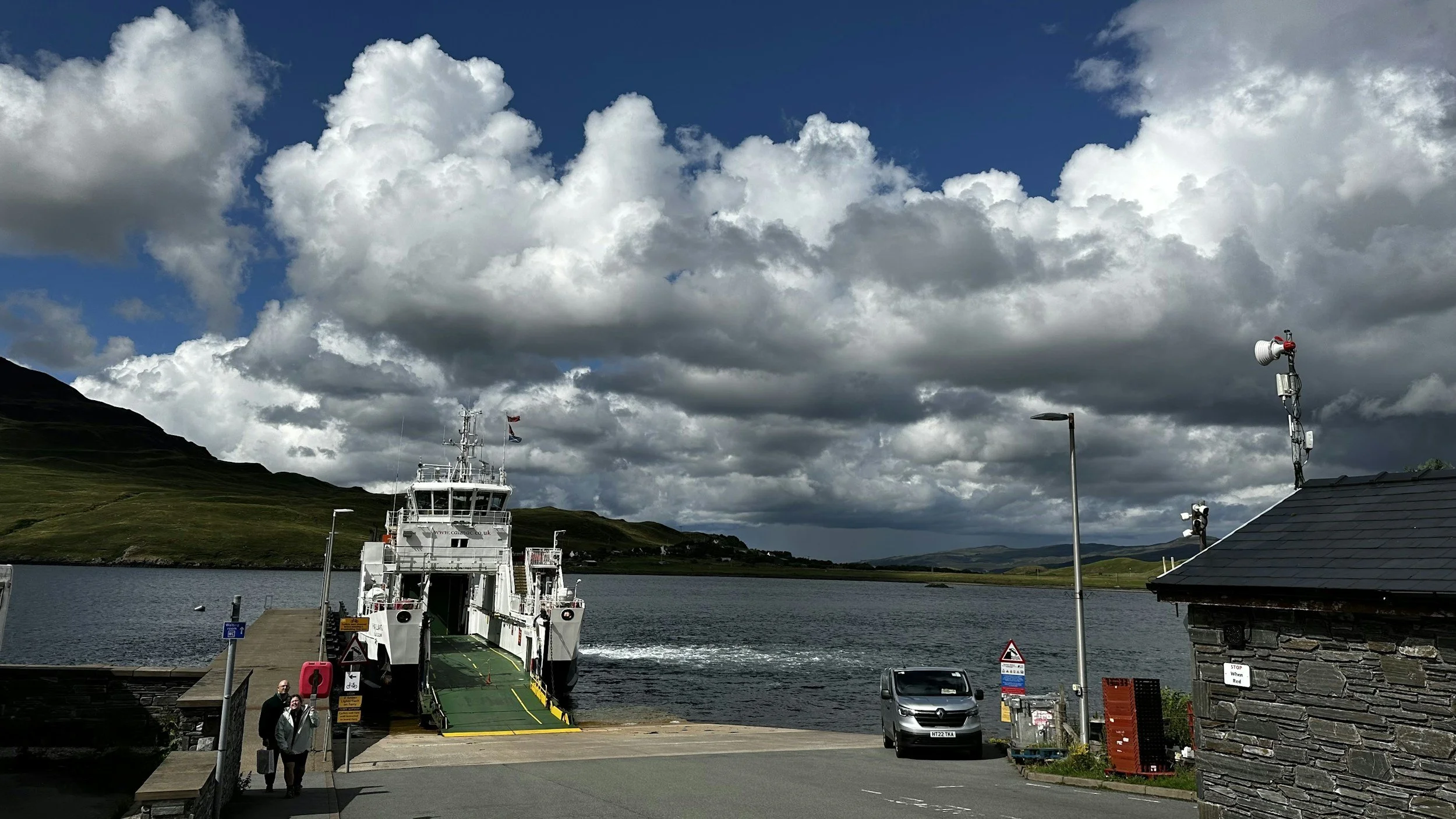
Ulva sits a one-minute ferry crossing from Mull's west coast. Most visitors to Mull never make it here. That is their loss.
Named "Wolf Island" by the Vikings, Ulva has been inhabited for at least 7,000 years. In past years it was home to 600 people. The Highland Clearances emptied it almost completely. Today there are under 20 residents — and the island is in the middle of a remarkable revival. In 2018 the community bought the island outright.
There are no tarmac roads, no cars, no phone signal worth mentioning. To summon the ferry, you slide a red panel on the pier — the ferryman sees it and crosses to collect you.
The Boathouse Restaurant near the landing serves locally caught shellfish. Sheila's Cottage is a beautifully restored thatched blackhouse. Livingstone's Trail, a 9km circular walk, takes in ruined townships, coastal views, and the Parliamentary Church designed by Thomas Telford in 1828.
Open Easter to October. Ferry Mon–Fri 9am–5pm, Sundays in June, July, August. Closed Saturdays. Adults £8 return, children £4, bicycles £2.